
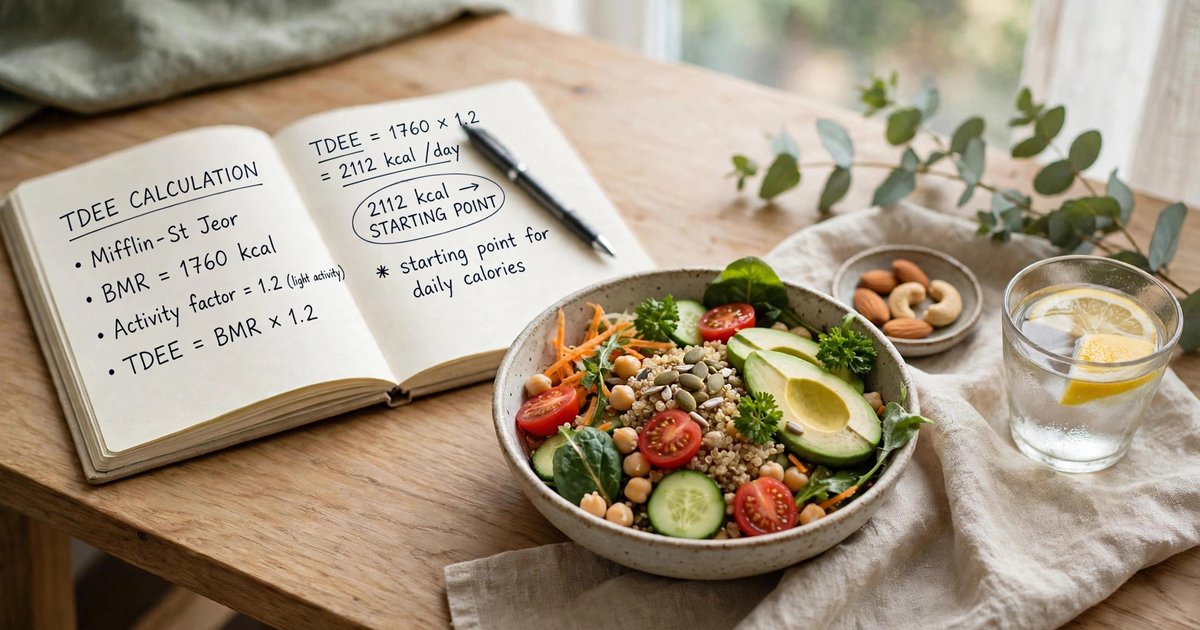
You enter your age, height, weight, and activity level into a calculator.
It returns 2,143 calories.
The precision looks reassuring. But those last three digits do not mean your metabolism has been measured.
What the calculator actually estimates
Equations such as Mifflin–St Jeor estimate resting energy expenditure from characteristics including weight, height, age, and sex.
Many calculators then apply an activity factor to estimate total daily energy expenditure. The result is a starting estimate, not a lab test or a prescription.
People with similar measurements can still differ in body composition, movement, health, and energy needs.
Activity labels are not universal
“Lightly active” and “moderately active” do not have one standard meaning across every calculator.
Read the definitions on the tool you use. Consider your whole day: a desk job plus a workout is different from an active job plus the same workout.
Avoid treating a particular step count as the official definition of an activity category unless the calculator actually says so.
Use the number as a starting point
The NIDDK Body Weight Planner is one example of a tool that combines calorie and activity planning.
Whatever tool you choose, expect uncertainty. Logging errors and short-term weight fluctuations can make a reasonable estimate look wrong.
Observe rather than constantly recalculating
If tracking supports your goals, try this:
- Record meals consistently, including drinks, sauces, and snacks.
- If you weigh yourself, use similar conditions.
- Compare trends over several weeks rather than reacting to one reading.
- Review activity, portions, and logging quality before changing your target.
- Make modest adjustments and observe again.
Two weeks can provide an initial signal, but it cannot prove your “true maintenance.” Water retention, menstrual cycles, illness, and changing activity can obscure the trend.
A stable average weight suggests your actual intake and expenditure may be roughly balanced over that period. It does not establish that the calorie number in your log is exact.
Avoid chasing a smaller number
A stall is not a reason to keep cutting food indefinitely. A suitable plan should support your health and everyday functioning.
If you need a personal calorie prescription, have a relevant health condition, or find tracking distressing, seek advice from a qualified professional.
Keep the feedback useful
FoodieTrack can help record your meals and estimated nutrition. Give it useful context such as portions, cooking method, and drinks.
Use the calculator to get started, the record to see patterns, and longer-term observations to guide sensible changes.